
Feature
A food diary and macro tracker you keep by saying what you ate
By Caleb King, founder of CoachhUpdated
Coachh keeps your food diary from plain words. Type or say "2 eggs and toast" and it logs the meal with calories, protein, carbs and fat, and shows what's left of today. It learns the foods you repeat, so "had my yogurt" logs your usual numbers, and "actually it was 3 eggs" fixes the meal instead of adding another one.
How it works, step by step
Step 1: Say what you ate
Type it or say it in the chat, in your own words: "chicken burrito bowl, no sour cream" or "a protein bar and a latte". A meal you mention for yesterday is logged on yesterday.
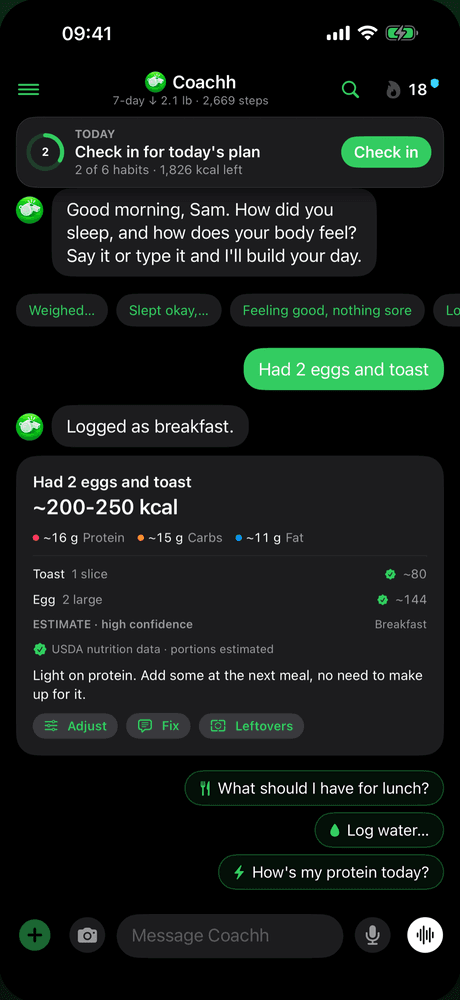
Step 2: See calories, macros and what's left
Each meal shows calories, protein, carbs and fat, item by item. The top of the chat shows what's left of today's calories, and the macros widget shows calories and protein left. Coachh suggests daily targets, and your own targets replace them whenever you set them.
Step 3: Fix it the way you'd say it
"Actually it was 2 eggs" fixes the last meal. "I only ate half" halves it. Removing an item updates today's totals, and deleting a meal takes it off. Any log can be undone from its card.
Step 4: Let it learn your usuals
A product you scanned once shows up as you type and logs its exact numbers in one tap. "My usual breakfast" or "had my yogurt" logs it straight away. Foods you haven't had in six weeks stop being suggested, and you can stop any suggestion yourself.
Step 5: Ask what to eat next
Ask what to have for dinner and you get three ideas from your own meals, one tap to log. Ask "should I eat a burrito?" and you get a straight answer that logs nothing until you say so. Every Sunday, the weekly review links what you ate to how your weight moved.
Do you have to search a database to track macros?
No. Most food diaries ask you to search a database, pick the right entry and choose a serving for every item. That takes real time: in a 2019 study of an online weight-control program, people spent an average of 23 minutes a day logging in the first month and about 15 minutes a day by the sixth.
Coachh starts from the sentence you'd text a friend. It splits the meal into items, estimates each portion and shows its work: every item, its amount and where the numbers came from, whether that's USDA nutrition data, a barcode or one of your own foods. If something's off, you fix it in words.
Amounts make it closer. "Chicken and rice" is an estimate; "150 g chicken and a cup of rice" is close to what a scale would say. For packaged food, scan the barcode for the label's exact numbers. For a restaurant plate, a photo is often quicker, shown as a range.
How is it different from MyFitnessPal-style logging?
It's built around a conversation instead of a grid. There's no breakfast, lunch and dinner table to fill in, and no tabs to switch between: the meal you mention goes in the same thread as your workouts, weigh-ins and how you slept, so the coach's answers about food know about the rest of your day.
The trade-offs are real. Coachh has no micronutrient tables, so it isn't the place to track iron or vitamin D, and it can't import your MyFitnessPal food history. If those matter, see MyFitnessPal alternatives for detailed trackers that do them well.
Can you look back at what you ate?
Yes. Everything lives in one thread, so your diary is searchable: find past meals and weigh-ins, newest first, or show just meals. You can also ask "what did I eat last Tuesday?" and Coachh looks it up. Your whole history, food included, is in your data export.
Each Sunday's weekly review puts the week's food next to how your weight trend moved, and the monthly recap on the 1st is built from your own numbers. Neither one is a verdict on you; they're a way to see patterns you'd miss day to day.
How does Coachh help with protein?
Coachh keeps protein in view without making you do the math. Each day's plan carries a protein range, a meal card notes when a meal is light on protein ("add some at the next meal, no need to make up for it"), and you can ask "how's my protein today?" at any point.
How much you need depends on your weight, age and training; how much protein do you need per day? walks through the research and has a calculator. Coachh also remembers what you tell it, so if you're vegetarian, its meal ideas are too.
What it’s good at
- Logging in about the time it takes to send a text, by typing or by voice.
- Fixing mistakes in plain words instead of hunting for the right entry.
- Repeat meals: your usual foods, with your numbers, in one tap.
- Seeing food next to training, sleep and weight, linked every Sunday.
Honest limits
- No micronutrient tables (vitamins and minerals) and no spreadsheet-style diary grid.
- It can't import a food history from MyFitnessPal or another app.
- A meal without amounts is an estimate; amounts or a barcode make it closer.
- There's no free tier: the food diary comes with Coachh Pro.
What does it cost?
Everything on this page comes with Coachh Pro, one subscription with everything in it: $119.99 a year or $19.99 a month (US prices). The yearly plan starts with a 7-day free trial; the monthly plan has no trial, and there’s no free tier. The full details, including how to cancel, are on the pricing page.
Compare apps and read more
Comparisons
Common questions
What's the easiest way to keep a food diary?
Say what you ate, when you eat it, in your own words. Coachh turns "2 eggs and toast" into a logged meal with calories and macros, remembers foods you repeat, and lets you fix mistakes by saying what changed.
Can I track macros without weighing my food?
Yes, with estimates. Coachh estimates portions from your words or a photo and shows each item's numbers. Adding amounts ("a cup of rice") or scanning a barcode makes them closer; a kitchen scale is still the most exact.
Can I set my own calorie and macro targets?
Yes. Coachh suggests daily targets, and your own nutrition targets replace them whenever you set them. Clearing yours goes back to the suggested ones.
Can I log meals for yesterday?
Yes. Say it was yesterday ("yesterday I had pizza for dinner") and the meal is logged on yesterday, not today. Meal photos are logged at the time they were taken.
Is my food diary private?
Yes. Coachh has no ads and never sells your data or uses it for advertising, and its usage analytics never carry what you ate. You can export or delete everything from the app.
Sources
- Log Often, Lose More: Electronic Dietary Self-Monitoring for Weight Loss. Obesity (Harvey J et al.), 2019.