
Feature
Workout plans that adjust to how you slept
By Caleb King, founder of CoachhUpdated
Coachh writes your workout plan from your goals, training days and equipment: a phased strength program, or strength plus a 5K or 10K, with today's session posted each morning. Tell it you slept badly or your shoulder is sore and today's workout gets lighter, with the reason, while the program itself stays put. Miss a session and it's picked up the next day, without doubling up.
How it works, step by step
Step 1: Tell it your goals and your week
Setup asks what you want, which days you can train, what equipment you have and how you like to train. With only a pull-up bar and dumbbells, no workout asks for a barbell or a machine. Building the plan can take a minute.
Step 2: Get a phased program
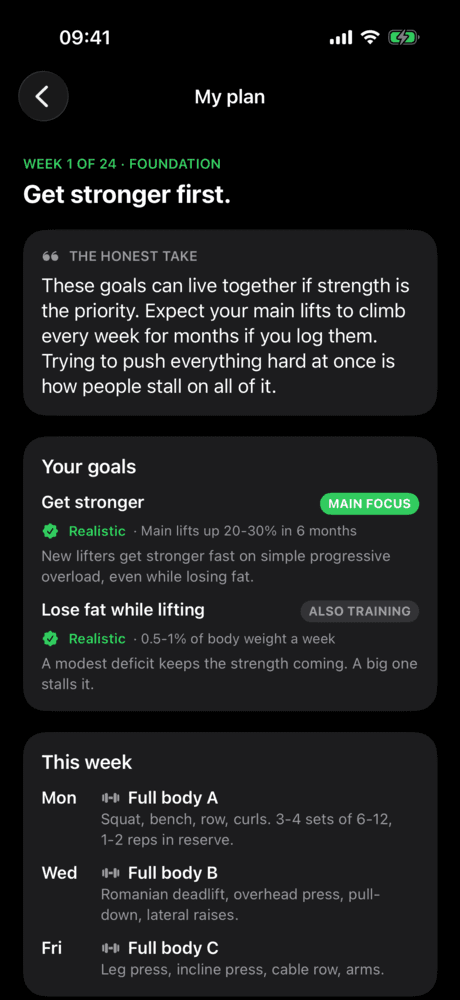
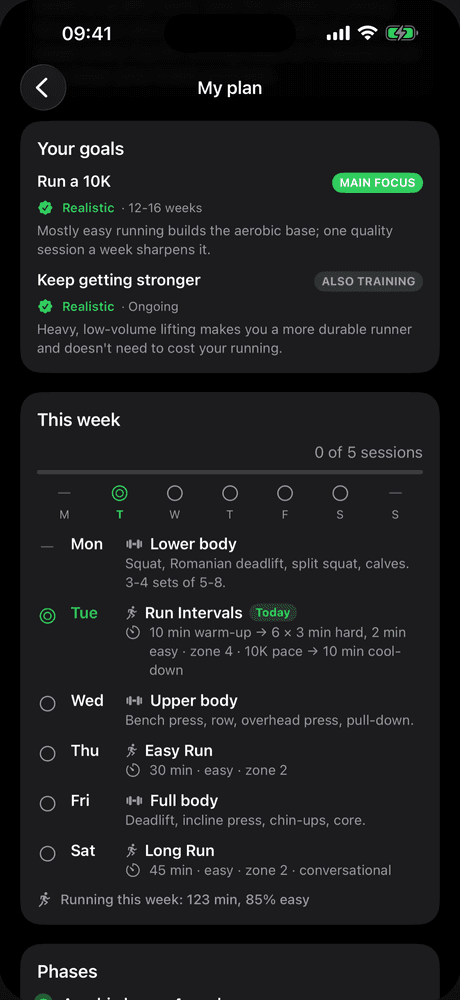
The program runs in phases, with a planned lighter week every few weeks. Each session keeps the same exercises week to week and only the load changes, so progress is easy to see. Beginners get at most four lifting days, and no session lands on a day you said you can't train. Add a race, such as a 10K, and the runs sit next to the lifting, mostly easy, with nothing hard right before a leg day.
Step 3: Check in each morning
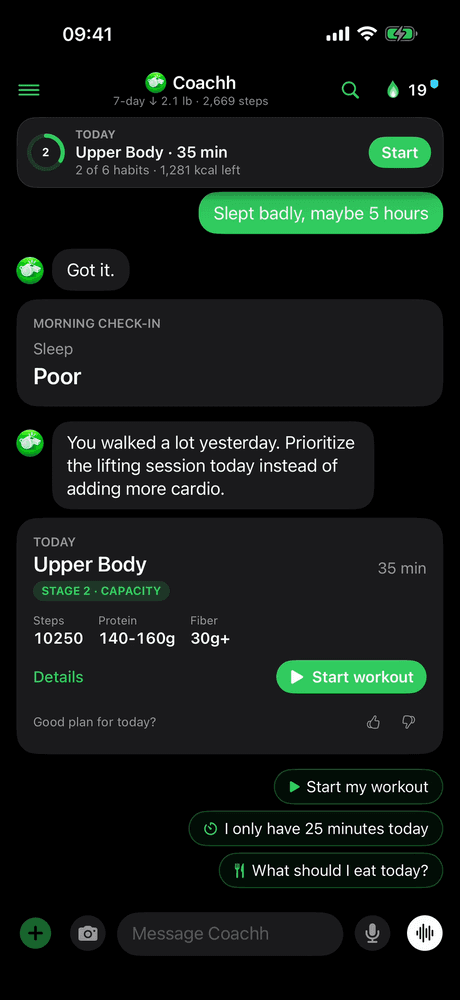
Say how you slept and how you feel, in a sentence. Coachh logs it, then posts today's session as a card, with the day's steps and protein targets.
Step 4: Today's session adjusts, and says why
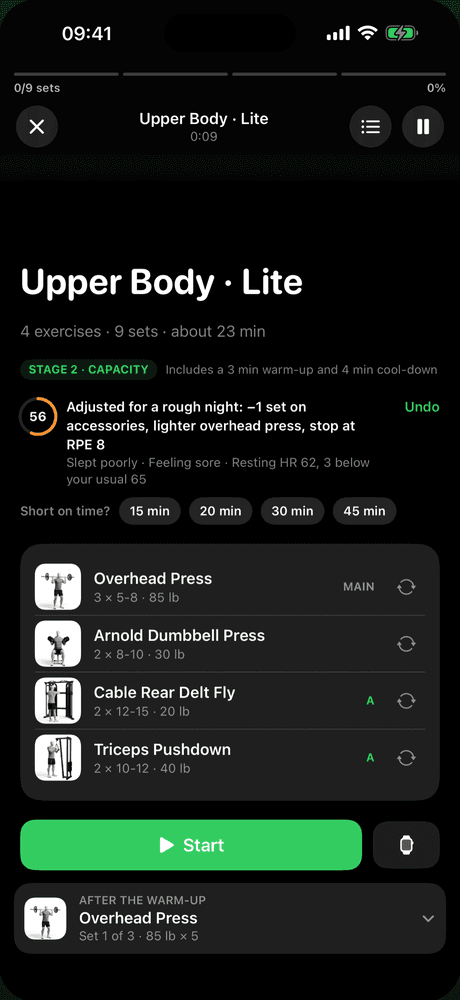
After a rough night, today's plan is lighter and tells you what changed: fewer accessory sets, a lighter main lift, stopping further from failure. After a great night it runs as written. One tap on Undo puts the full session back.
Step 5: Train it in the player
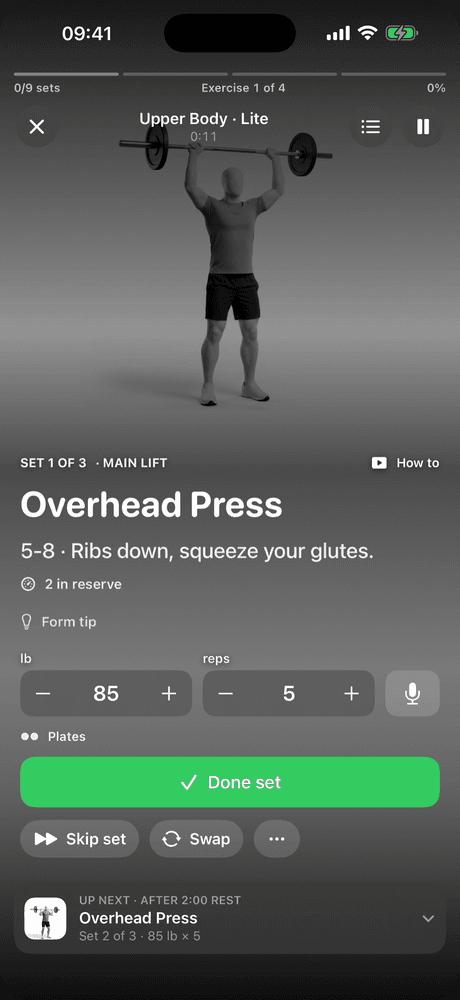
Weights are filled in from last time, main lifts start with warm-up sets, and each exercise shows its 3D demo, or photos where there isn't one yet. Say "185 for 6" to fill in a set and "done" to log it. A heavier lift than ever before is called out as a personal record.
Can a workout app adjust to your sleep and soreness?
Coachh does, every morning. You tell it how you slept and how your body feels, and if you connect Apple Health it also sees last night's sleep and heart data. Today's plan then follows what actually happened:
- After a rough night, today's session gets lighter and says why. In the example above, that's one set fewer on accessories, a lighter overhead press and stopping at RPE 8.
- After a great night, the session runs as written, with a green light.
- When something's sore, today goes easy on it without changing your program for good.
- With a lasting injury, tell the coach once and new sessions steer away from what aggravates it.
- On a run day, a rough night turns hard intervals into an easy run, and the plan says so.
- Feeling sick or in real pain always means taking it easy.
Undo brings back the full session whenever you'd rather push on. The program itself, its phases and its progression, stays put; only today changes.
What happens when you miss workouts or take time off?
Missing a day is normal, so the plan expects it. When you miss a session, today picks it up instead of skipping ahead. Only one missed session is made up, rest days stay rest days, and a new week starts clean. Training a day late still counts as that day's session.
Longer breaks are eased, not punished:
| Time away | What the next sessions do |
|---|---|
| Up to 3 days | Nothing changes: it's an ordinary day |
| 4 to 7 days | Same weights, one set fewer on accessories |
| 8 to 14 days | About 10% lighter and a step easier, back to full within two sessions |
| 15 days or more | The week trains one stage down; nothing restarts from week one |
Each session back steps closer to the full plan, and a rough night on your first day back takes whichever change is more conservative, not both. The thinking behind this is in how to stay consistent with working out.
Is it a good workout plan app for beginners, including over 35?
Coachh has no special program for people over 35, and it can't replace a doctor's advice, but it's built to give any adult beginner a careful start:
- A manageable week. Beginners get at most four lifting days. The CDC's guidance for adults calls for muscle-strengthening activity on at least 2 days a week, plus 150 minutes of moderate activity such as brisk walking.
- Starting weights you don't have to guess. A lift you've never done helps you find your working weight, and after that your first set comes from your estimated max and the day's target effort.
- Warm-ups and demos. Main lifts start with warm-up sets, every exercise has a 3D demo or photos, and the "Walk me through it" coaching style spells out the warm-up.
- Recovery built in. A planned lighter week every few weeks, easier days after bad sleep or soreness, and walking counted as recovery, not fatigue.
If you have a heart condition, joint problems or haven't exercised in years, check with your doctor first. And if you want someone to watch your form in the room, a trainer is worth it for a few sessions: see what a personal trainer actually does.
Can you change the plan?
Yes, by asking. Training fewer days a week shrinks every week of the plan, an injury is saved and its moves swapped, and a change that makes sense is applied with the program keeping its start date. You can move today's session to tomorrow, and "I only have 25 minutes" fits the session to the time while keeping the main lift.
Coachh is also honest when a change would pull you off track: asking to switch plans in week one gets a straight no, and nothing changes. Swapping an exercise keeps the movement and brings that exercise's own history, "I hate burpees" keeps them out of your plans, and telling it you want to work on a skill, such as a handstand, adds daily practice.
Want to lift and run? Coachh writes hybrid plans with runs next to the lifting. Want the session on your wrist? See Apple Watch set logging. Want to see a whole program before you start? Browse complete strength programs, written on the same rules the app plans with.
What it’s good at
- Plans built around a real week: the days you can train and the equipment you have.
- Adjusting today for sleep, soreness or time without rewriting the program.
- Coming back after time off without starting over.
- Strength and running in one plan, with runs from your Watch or Strava counting toward it.
Honest limits
- It isn't a person and can't watch your form; for pain or technique problems, see a qualified coach or physical therapist.
- There's no special program for older adults or for medical conditions.
- No community or group programs, and no human coach to message.
- Building a new plan can take a minute, and there's no free tier.
What does it cost?
Everything on this page comes with Coachh Pro, one subscription with everything in it: $119.99 a year or $19.99 a month (US prices). The yearly plan starts with a 7-day free trial; the monthly plan has no trial, and there’s no free tier. The full details, including how to cancel, are on the pricing page.
Compare apps and read more
Comparisons
Guides
Common questions
What's the best app for workout plans?
It depends on whether you want the plan written for you. Coachh writes and adjusts it from your goals, days and equipment; log apps like Hevy and Strong are better if you bring your own program; Ladder suits people who want a team program with a community.
Is there an app that adjusts my workout to how I slept?
Yes. Coachh asks how you slept each morning and, after a rough night, makes today's session lighter and says why, with Undo if you'd rather do the full session. After a great night it runs as written.
Can Coachh make a home workout plan with just dumbbells?
Yes. Tell it what you have during setup, or later in the chat. If you only have a pull-up bar and dumbbells, no workout asks for a barbell or a machine.
How many days a week will my plan have?
As many as you say you can train, and never on a day you can't. Beginners get at most four lifting days. Training fewer days later shrinks every week of the plan.
Can I do a 15-minute workout instead?
Yes. Say you only have 15 minutes and you get the short version: the main lift first with a short warm-up, 15 minutes all in. It counts as showing up and keeps your streak.
Sources
- Adult Activity: An Overview. Centers for Disease Control and Prevention.